
i-Lab Students Showcase Global Solutions in Action
Students from the Masters of Global Affairs program at the Keough School of Global Affairs recently showcased their initial research findings during the 2024 i-Lab Global Partnership Experience.
Students from the Masters of Global Affairs program at the Keough School of Global Affairs recently showcased their initial research findings during the 2024 i-Lab Global Partnership Experience.

On Tuesday, October 29, 2024, members of the Supporting Holistic and Actionable Research in Education (SHARE) team presented to …
As the world grapples with the accelerating impacts of climate change, disaster preparedness and recovery strategies are shifting to meet the demands of a more volatile and interconnected landscape. Traditional frameworks that treat disasters as isolated events are now outdated in the face of back-to-back catastrophes, where regions barely have time to recover before the next blow. These "compounding disasters" create new challenges, with infrastructure and communities struggling to withstand the cumulative effects. This evolving reality calls for bold, innovative thinking and transformative leadership.

African migrant men working in South Korea are disproportionately harmed by societal pressures to conform to gender norms, according to a new study co-authored by Keough School sociologist Sharon Yoon. The study which was published in Gender, Work & Organization, detailed the experiences of men who work in physically demanding and low-paying jobs.

The University of Notre Dame recently announced the appointment of Arun Agrawal, a renowned scholar of environmental politics and sustainable development, as the inaugural director of the Just Transformations to Sustainability…

Arun Agrawal, a renowned scholar of environmental politics and sustainable development, will join the University of Notre Dame on Jan. 1, 2025, as the inaugural director of the Just Transformations to Sustainability Initiative, a key priority in the University’s strategic framework.

The Forests and Livelihoods: Assessment, Research, and Engagement Network (FLARE) is an international community of researchers, practitioners, and policymakers committed to developing greater knowledge at the intersection of forests and livelihoods and applying it to policy and practice.

Meet Eric Goins, a 30-year-old U.S. Army veteran and Fighting Irish kicker who is a student in Notre Dame's Master of Global Affairs / Master of Business Administration dual degree program.
Here, Goins shares about his experience at Notre Dame, including the Keough School,…

Water insecurity is one of the most pressing global crises caused by climate change. In fact, half the world’s population is projected to live in water-scarce regions by 2050, and some 700 million people will be displaced by water scarcity as early as 2030, according to the United Nations.
Pacific…
Keough School Master of Global Affairs student Beverly Ndifoin is bringing evidence to impact in her home country of Cameroon, utilizing research to advocate with policymakers to integrate trees into existing agricultural systems to reduce poverty and improve lives.
In early 2024, Ndifoin completed…

Justin Hur is a Notre Dame junior at the Keough School majoring in global affairs and pursuing a minor in social entrepreneurship and innovation (SEI). Justin shares what he’s learned through his experiences and how they have prepared him to be a force for good in the world.

In this conversation, Paul Winters, associate dean for academic affairs at the Keough School of Global Affairs at the University of Notre Dame, reflects on the 79th session of the United Nations General Assembly as well as opportunities to drive progress on food security and poverty through scientific innovation and policy action.

There is no rest for weary Florida residents who have yet to recover from Hurricane Helene. Less than two weeks since the Category 4 storm made landfall, battering the state and surrounding southeast region, another major hurricane is charting a dangerous path toward Florida’s Gulf Coast.
Hurricane…

Weather-related disasters such as earthquakes, hurricanes, floods and droughts displace about three times as many people as conflicts and violence do worldwide. From 2008 to 2018, around 263 million people were forced by extreme weather events to move within their own countries’ borders, a number that is expected to rise as climate change increases the frequency and intensity of weather-related disasters. A new study by University of Notre Dame researcher Sisi Meng shows that environmental governance — policies, rules and norms that govern human behavior and scientific information needed for decision-making — can mitigate this displacement.

The University of Notre Dame’s Forests and Livelihoods Assessment, Research, and Engagement (FLARE) Network will gather in Rome, Italy, from October 3-7, 2024, for its 10th Annual Meeting. The 2024 FLARE Annual Meeting, hosted by the Keough School of…
On September 24, 2024, USAID's Global Reading Network hosted "Increasing…

Continued, principled U.S. participation and leadership at the U.N. is not simply a diplomatic politesse, but a necessary way forward towards creating a safer, sustainable, more prosperous world.
Current data shows the world is 43 years behind schedule to meet the 2030 U.N. Sustainable Development Goals (SDGs), a shared global and domestic agenda intended to improve quality of life for people and the planet.
In recent discussions with Hill policymakers, Pulte Institute researchers emphasized the University’s global impact and commitment to data-driven policy solutions to some of the world's biggest challenges.
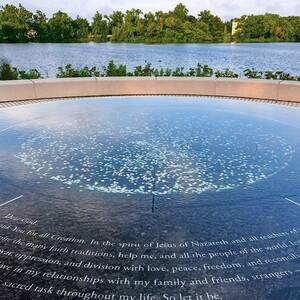
The Keough School of Global Affairs will observe the International Day of Peace with two campus events: a prayer service featuring University President Rev. Robert A. Dowd, C.S.C., on Friday (Sept. 20) and a talk by a Notre Dame graduate who serves in the Sierra Leone government on Tuesday (Sept. 24). Both events are free and open to the public.