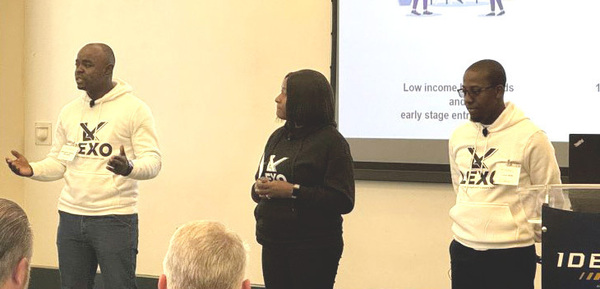
Mandela Washington Fellowship alums Simbarashe ‘Simba’ Absolom Murondoti (left) and Oluwafunke ‘Funke’ Adeoye (center) teamed up with recent Notre Dame Mendoza College of Business graduate Tafara Moyo to create LEXO, an app to connect economically disadvantaged individuals and small businesses in Southeast Africa with prepaid legal services. In May 2024, the trio pitched their startup at the Notre Dame IDEA Center’s McCloskey New Venture Competition.
Simbarashe ‘Simba’ Absolom Murondoti, a 2023 University of Notre Dame Mandela Washington Fellowship alum, returned to campus in May to participate in the IDEA Center’s McCloskey New Venture Competition. He recently shared his experience with the Pulte Institute.
Simba Murondoti, a senior partner at Absolom & Shepherd Attorneys, is a pivotal figure in Zimbabwe’s legal community. With expertise in corporate and commercial law and a career studded with significant achievements — including recovering $5.6 million in a complex multi-jurisdictional investment dispute and providing expert counsel on the country’s currency regulations in proceedings before a European court — Simba has significantly impacted the African legal landscape, with his influence extending well beyond the judicial sector.
Simba was an invited delegate at the Tony Elumelu Entrepreneurship Forum, the largest gathering of African entrepreneurs and investors across the continent. At the U.K.’s Wilton Park Conference — a prestigious forum for policymakers, academics, business leaders, and experts to discuss global development issues — he addressed ways to enhance safety measures on Afro-Eurasian college campuses.
In 2023, following a competitive application process, Simba was selected to participate in the Mandela Washington Fellowship at the University of Notre Dame. The Fellowship, hosted by 28 higher-education institutions across the U.S. and sponsored by the State Department, strives to empower young African leaders (ages 25 to 35) by equipping them with the skills needed to excel in their sectors and uplift their communities.
At Notre Dame, Simba conceived the idea for LEXO, an app that connects clients with prepaid legal services. The platform will allow people to pay a set amount monthly and have an attorney available when needed. (The name is derived from Lex, the Latin word for law.)
“Apart from opening doors, being on campus opened my mind,” Simba said. “I consider myself blessed because Notre Dame was the perfect place for me. The people were amazing in how much they were willing to help, which led to me thinking about how I might apply some of the lessons of growing the good in business.”
Simba credits his Mandela Washington Fellowship at the University of Notre Dame mentor, Sam Miller, with helping him set business goals and objectives. Together, they developed a roadmap to identify and manage risk, secure employee buy-in, and execute strategy. Simba said his Notre Dame experience “made me realize that creating a tool to harness the transformative power of law could be possible.”
Meeting Oluwafunke ‘Funke’ Adeoye from Nigeria, a participant in the Washington Mandela Fellowship at the University of Georgia, affirmed this notion. Funke, also an attorney, was honored in 2023 with a Waislitz Global Citizens’ Choice Award for advocating for 8,500 Indigenous people who couldn't afford representation.
After six weeks at over two dozen higher education institutions across the U.S., all 700 Mandela Washington Fellowship participants gather for a three-day summit in Washington, D.C. This event provides an opportunity for Fellows to engage with government officials, business leaders, and each other, nurturing relationships that frequently develop into lasting partnerships.
“At the summit, someone who heard my Ignite Talk on LEXO approached me and said, ‘Oh my word! What are the odds?’ Funke is working on the same project," Simba said. "We met and decided to collaborate on our shared mission.”
The LEXO team is completed by Tafara Moyo, whom Simba and Funke connected with this spring while participating in the McCloskey New Venture competition.
"McCloskey has a great program that pairs you with Notre Dame students interested in your project," Simba explained. "We met Tafara during one of the matchmaking sessions." Tafara earned a master’s degree in business analytics from Notre Dame's Mendoza College of Business in 2024.
LEXO aims to democratize access to justice by offering affordable legal services through a microinsurance model. Subscribers pay a monthly premium, guaranteeing access to representation if needed. The software is currently pending regulatory approval.
In many African countries today, legal proceedings suffer from delays and inefficiencies due to under-resourced systems. The high cost also limits access, particularly affecting the informal sector, where small-scale and self-employed businesses often operate without contracts — and face significant challenges when legal issues arise.
This gap presents an opportunity for ventures that address unmet needs and provide accessible support services. Simba and his partners are ready to close this divide.
Upon his return to Notre Dame to participate in the McCloskey New Venture Competition — an annual event that promotes entrepreneurship and innovation, often offering funding opportunities for market-ready ideas like LEXO — the Pulte Institute spoke with Simba about his startup.
Simbarashe ‘Simba’ Absolom Murondoti is a partner with the Zimbabwean law firm Absolom & Shepherd Attorneys and a 2023 alum of the Washington Mandela Fellowship at the University of Notre Dame. He spoke with the Pulte Institute about his prepaid legal services app, LEXO. Simba returned to campus in May 2024 to participate in the University of Notre Dame IDEA Center’s McCloskey New Venture Competition. His startup, LEXO, takes a unique approach to making legal services affordable, aiming to serve those who cannot afford them. Using a microinsurance model, individuals in Southeast Africa will soon be able to secure legal representation by paying a lower-end monthly premium.
Q. Explain why there is a need for a legal service option like LEXO.
In Zimbabwe, for instance, we've got the legal aid system that is state-funded, but it's only working for murder cases. Other legal aid societies have tried to use a similar model, and they failed for two reasons: they weren’t licensed and assumed too much risk without calculating the premiums. They just dreamt up a figure, and people started paying. When it came time for people to get representation, lawyers did not want to accept it because they did not have a guarantee that they would get paid.
One of Africa’s most unsung problems is the lack of access to legal services. The continent is encouraging startups, but how do startups grow if they don't have legal representation? The only way I can think of addressing these problems is by allowing a startup to pay a small monthly premium (LEXO’s lowest-priced silver membership is expected to cost $12.90 per month) and be covered against the risk of needing crucial legal representation.
More than 70 percent of people in Zimbabwe and Nigeria cannot access basic legal services because they are exorbitantly priced. The average case costs $3,000; most people earn between $200 and $300 monthly.
In Zimbabwe, we've got a pro-Deo system. Attorneys must do a murder case on an annual basis. Never mind, if you’re a tax lawyer, you must represent this poor guy who's been accused of murder. The tax lawyer is not getting paid; he’s being forced to do it, which is way outside his ballpark. So, there's no telling the levels of carelessness with which the cases are approached.
Q. What did you learn from participating in the McCloskey New Venture Competition?
I learned a lot about raising finance. I also learned humility because there were many incredible businesses. We were taken aback at the level of innovation going on at Notre Dame. Specifically, for Lexo, we made a lot of crucial connections, especially in the venture capital space, some of whom were still in discussions.
I also got incredible mentorship from the judges. They got me thinking about applying this idea beyond Zimbabwe and Nigeria, which we initially targeted. One judge approached me and said, “You know, you've got something here that could be useful for the immigrant populations in the United States.” So, those kinds of insights. It was a week of getting information and inspiration.
Q. Is the LEXO app up and running? Would someone be able to sign up today?
No, it is pending approval. We are not permitted to do the insurance business before we get regulatory approval. Once we get that, as far as the Zimbabwean market is concerned, we'll be ready to offer the service.
LEXO is built on a microinsurance model. We aim to help the poorest of the poor, low-income households, and people who get into trouble with the law and cannot afford legal services.
Eventually, we want the market to see that we are not doing this out of any ulterior motive. We are doing this to solve a legitimate problem with premiums commensurate with an attorney’s basic hourly charge. We are intentionally targeting the lowest premiums possible because we know that money is an issue.
That should be enough, at least in the early stages of our relationship with customers, to demonstrate that we're not here to solve their problems. Their problems will be solved in a manner that's profitable for us. We would be disingenuous if we didn't admit that this venture strives to be profitable. If we get into a case that requires representation beyond what we have figured, we will allow clients to supplement their premiums with a substantial payment.
LEXO is insurance. The more people we have, the better we can manage the risk of them encountering legal issues.